









If you are still controlling pump output with throttle valves or bypass lines, you are paying for energy that produces no useful work.
Every kilowatt-hour consumed to overcome unnecessary system pressure is money thrown away — and in facilities where pumps run thousands of hours per year, those losses compound into staggering sums.
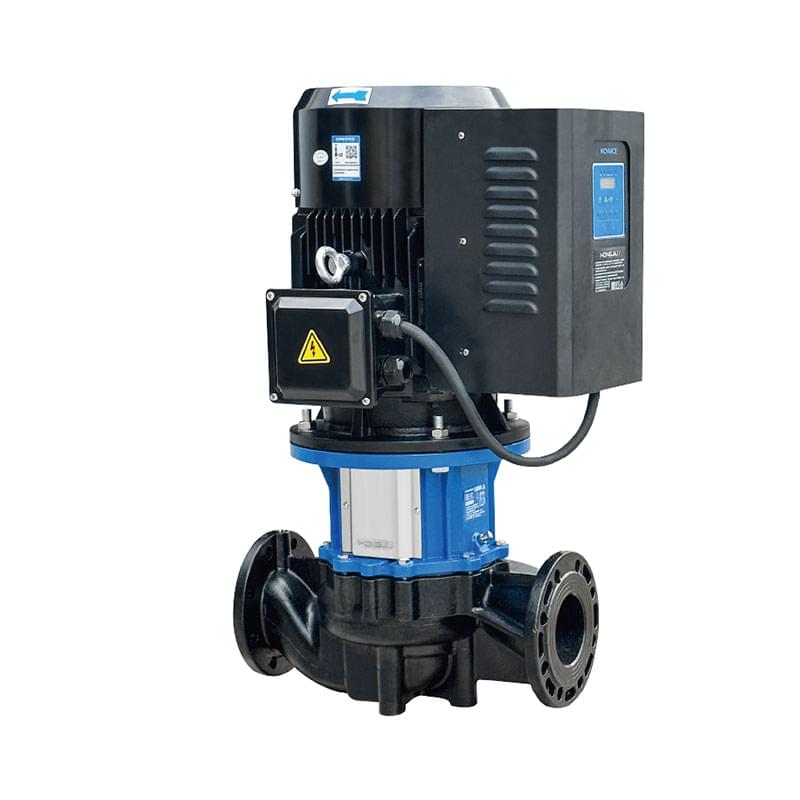
The HPLE variable speed inline pump from Hongjiu eliminates this waste at its source. By integrating a high-quality variable frequency drive (VFD) directly into the pump assembly, the HPLE adjusts motor speed automatically to match actual system demand — delivering only the pressure and flow the system needs, nothing more.
The result? Energy savings of 20–40% compared with conventional fixed-speed control strategies, with typical payback periods of 1–3 years. After that, every saved kilowatt-hour goes straight to your bottom line.
Why Variable Speed Control Beats Throttle Valves Every Time
To understand why a variable speed inline pump delivers such dramatic savings, it helps to look at how traditional systems waste energy. In a typical fixed-speed pumping installation, the pump runs at constant full speed regardless of actual demand. When the system needs less flow, excess pressure is dissipated through a control valve or bypass line.
This is analogous to driving your car with the accelerator pedal pressed to the floor while controlling speed with the brake. The engine burns maximum fuel regardless of how fast you are actually going.
The VFD in the HPLE works differently. It follows the pump affinity laws, which describe the mathematical relationship between speed, flow, head, and power:
- Flow is proportional to speed (Q ∝ n)
- Head is proportional to speed squared (H ∝ n²)
- Power is proportional to speed cubed (P ∝ n³)
The cubic relationship is the key insight here: reducing motor speed by just 20% cuts power consumption by approximately 50%. This is not marginal efficiency improvement — it is a fundamental shift in how pumping energy is used.
Integrated VFD Engineering — Built for Reliability
Not all VFD-equipped pumps are created equal. The quality of the drive unit determines everything from energy-saving performance to long-term reliability. Hongjiu has selected VFD partners based on proven field track record, not lowest purchase price.
| Power Range | VFD Brand | Rationale |
|---|---|---|
| Models ≥ 3 kW | Inovance | China’s largest VFD manufacturer; MTBF >50,000 hours; global installations in millions of industrial/commercial applications |
| Models < 3 kW | Huizhi | Compact, cost-effective drive optimized for small-horsepower pump applications; reliable performance in space-efficient package |
Why Inovance for Larger Models
Hongjiu is recognized globally as a leader in industrial automation and drive technology. Their VFDs used in the HPLE series offer:
- Wide voltage tolerance with strong grid adaptability — important for facilities with unstable supply power
- Comprehensive built-in protections including overcurrent, overvoltage, undervoltage, overheating, phase loss, and dry-run detection
- Full-featured PID control for precise pressure or flow regulation without an external controller
- Modbus RTU communication (RS485) standard for integration into building management systems
Rainproof Enclosure — Install Anywhere
Every HPLE model ships with a rainproof enclosure rated for outdoor or semi-outdoor installation. This eliminates the need for a separate electrical cabinet in many applications, reducing panel costs, wiring runs, and installation labor.
The enclosure protects VFD electronics from rain, splashing, and condensation while maintaining adequate airflow for cooling — a design balance that many competitors struggle to achieve.
Technical Specifications
| Parameter | Specification |
|---|---|
| Series | HPLE (VFD-Equipped) |
| Base Pump Platform | HPL vertical direct-connect inline pump |
| Flow Range | 4 – 170 m³/h |
| Head Range | 4 – 47.5 m |
| Nominal Diameter | DN25 – DN80 |
| Standard Pressure Rating | 1.6 MPa (16 bar) |
| Optional High Pressure | 2.5 MPa (25 bar) |
| Medium Temperature Range | -25°C to +110°C |
| Primary Power Supply | 3×380–415V 50Hz (three-phase) |
| Single-Phase Option | 1×220–240V, max 2.2 kW |
| Motor Efficiency Class | IE2 / IE3 |
| Bearing Brand | NSK / SKF (sealed for life) |
| Speed Control Range | 20–60 Hz typical |
| VFD Communication | Modbus RTU (RS485), built-in keypad |
Performance Snapshot — Selected Models
| Model | Power (kW) | Max Flow (m³/h) | Max Head (m) | VFD Brand |
|---|---|---|---|---|
| HPLE25/105-11/11-0.75/2 | 0.75 | 11 | 11 | Huizhi |
| HPLE32/135-14/18-1.5/2 | 1.5 | 14 | 18 | Huizhi |
| HPLE40/160-30/40-5.5/2 | 5.5 | 30 | 40 | Inovance |
| HPLE50/160-33/70-11/2 | 11 | 33 | 70 | Inovance |
| HPLE65/150-32/90-11/2 | 11 | 32 | 90 | Inovance |
| HPLE80/125-20/150-11/2 | 11 | 20 | 150 | Inovance |
Note: Performance values shown represent maximums at rated speed (50 Hz). Actual operating points vary based on system resistance curve and VFD setpoint configuration. Contact our engineering team for duty-point-specific performance data.
Constant Pressure Control: The Smart Way to Manage Water Supply
One of the most valuable features of the variable speed inline pump is its ability to maintain constant discharge pressure regardless of how much water the system is actually drawing. This capability transforms how buildings manage their domestic water supply:
How Constant Pressure Works
- A pressure sensor (installed on the discharge piping or at a remote point) measures the actual system pressure
- The VFD’s built-in PID controller compares the measured pressure against your setpoint
- If pressure is below setpoint, the VFD increases motor speed; if above, it decreases speed
- The adjustment happens continuously and smoothly — no sudden pressure spikes or drops
Why This Matters for Your Facility
For hotels, hospitals, apartment buildings, and commercial offices, water demand fluctuates dramatically throughout the day. Morning shower peaks, lunchtime kitchen demand, evening occupancy patterns — each creates a different load profile. With a fixed-speed pump, you either maintain constant pressure by wasting energy through a pressure-reducing valve, or you accept pressure fluctuations that affect tenant comfort.
The HPLE’s constant pressure mode gives you both: stable pressure at all demand levels, and energy consumption that scales proportionally with actual usage.
Water Shortage Protection Built In
Running a pump dry is one of the fastest ways to destroy a mechanical seal and damage bearings. The HPLE’s integrated VFD includes dry-run protection as a standard feature:
- The drive monitors motor current and operating parameters for signatures indicating dry-running conditions
- Upon detecting potential dry-run, the VFD stops the motor and triggers a fault alarm
- Configurable auto-restart allows the pump to resume operation once water supply is restored
- This protection operates without requiring an external level sensor (though external sensors can be integrated for additional reliability)
For unattended installations — remote booster stations, rooftop tanks, automated process loops — this built-in protection provides peace of mind that a standalone fixed-speed pump simply cannot match.
Energy Savings in Real Scenarios
Theory is useful, but what do the savings actually look like in practice? Here are two representative scenarios based on real-world HPLE installations:
Scenario 1: Hotel Domestic Water Boosting
A mid-sized hotel with 200 rooms experiences dramatic daily demand variation — from 30% of rated capacity during low-occupancy nighttime hours to nearly 100% during morning and evening peak periods.
| Parameter | Fixed-Speed System | HPLE Variable Speed System |
|---|---|---|
| Demand Pattern | 40–100% of rated flow | Same profile |
| Control Method | Pressure-reducing valve (wastes excess head) | VFD speed modulation |
| Annual Energy Use (baseline) | 100% | 60–75% |
| Estimated Annual Savings | — | 25–40% reduction |
| Payback on VFD Premium | — | 1.5 – 2.5 years |
Scenario 2: HVAC Chilled Water Circulation
A commercial office building chilled water system experiences seasonal load variation — from 100% cooling load in peak summer to 50% or less during spring and autumn shoulder seasons.
| Parameter | Fixed-Speed (Two-Speed or Throttle) | HPLE with Temperature Feedback |
|---|---|---|
| Seasonal Load Range | 50–100% cooling load | Same demand profile |
| Control Method | Manual switching or throttle valve | VFD modulates per chiller staging signal |
| Annual Energy Use (baseline) | 100% | 55–70% |
| Estimated Annual Savings | — | 30–45% reduction |
| Payback on VFD Premium | — | 1.0 – 2.0 years |
In both scenarios, once the VFD premium pays back through electricity savings, every subsequent year of operation delivers pure cost reduction that compounds for the remaining service life of the equipment.
Multiple Control Modes for Every Application Architecture
The HPLE’s integrated VFD supports several control strategies to match different system requirements:
Constant Pressure Control (PID) — Maintains fixed discharge pressure regardless of flow variation using feedback from a pressure transmitter. Ideal for domestic water boosting and pressure-maintaining systems.
Constant Temperature Control — Adjusts pump speed based on temperature sensor input. Perfect for HVAC chilled water and heating circulation systems where temperature is the controlled variable.
Constant Flow Control — Maintains fixed flow rate via flow meter feedback. Used in process applications requiring precise delivery volumes.
Multi-Pump Parallel Control — For installations running multiple HPLE units together, external controller options support master-follower cascade operation with automatic lead/lag alternation and duty rotation for balanced equipment wear.
Applications Where the Variable Speed Inline Pump Delivers Maximum Value
The HPLE excels wherever flow or pressure demand varies significantly over time:
- Commercial water supply — Hotels, hospitals, shopping malls, and office buildings with variable occupancy patterns
- Residential boosting — Apartment complexes with pronounced morning/evening peak demand
- HVAC systems — Chilled water and heating circulation with seasonal and daily load variation
- District heating secondary loops — Heat demand that follows weather patterns
- Solar thermal circulation — Variable-speed operation matching solar irradiance levels
- Industrial process water — Batch processes, cleaning circuits, and cooling systems with intermittent demand
Quality Assurance from Factory to Field
Every HPLE variable speed inline pump leaves Hongjiu’s ISO 9001:2015 certified facility having passed:
- Hydrostatic pressure testing at 1.5× rated pressure on the wet end
- Full-load VFD functional testing including PID tuning verification
- Performance curve confirmation on calibrated test rigs
- Bearing authenticity verification (NSK/SKF from authorized channels)
- Electrical safety and insulation resistance testing
- Rainproof enclosure integrity validation
Ready to Calculate Your Savings?
Converting from fixed-speed to variable-speed pumping is one of the highest-ROI energy investments available to facility operators. Our engineering team can provide a complimentary energy savings analysis for your specific application, including projected annual savings, payback period calculation, and VFD configuration recommendations.
Request your free energy analysis | Speak with an application engineer
Related Products
- HPL Series Overview — Complete family comparison across all three variants
- HPL Standard Pump — Fixed-speed variant for constant-duty applications
- HPLYE Permanent Magnet Pump — Ultra-efficient PM VFD variant with even greater energy savings (up to 50%)