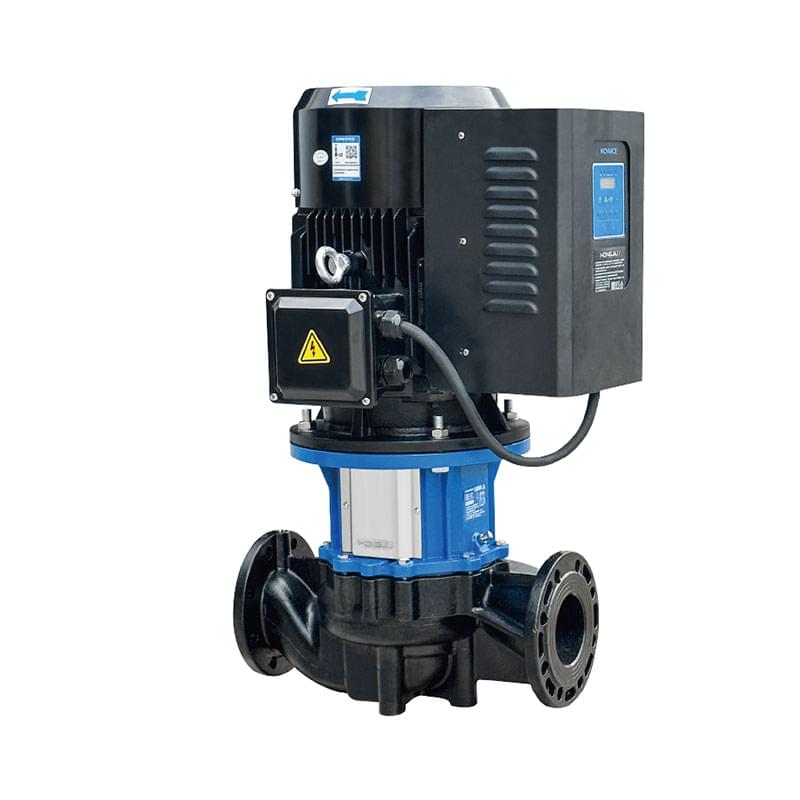










Energy costs represent one of the largest operating expenses for any facility that moves water continuously — hotels, hospitals, apartment buildings, commercial offices, and industrial plants all feel the impact of rising electricity prices on their bottom line. The permanent magnet inline pump from Hongjiu’s HPLYE series attacks this cost center directly with technology that was simply unavailable to building engineers just a few years ago.
By combining an IE5-class permanent magnet synchronous motor with an integrated variable frequency drive purpose-built for PM control, the HPLYE achieves efficiency levels that conventional induction motor pumps cannot approach — especially at the partial-load conditions where real-world systems spend most of their operating lives.
The result is energy savings of 30–50% compared with traditional fixed-speed pump systems, with payback periods as short as 1–2 years for high-runtime applications.
Why Permanent Magnet Inline Pump Motors Outperform Induction
To understand why the permanent magnet inline pump delivers such dramatic efficiency gains, it helps to examine the fundamental difference between the two motor technologies that dominate the pumping market today.
Conventional pumps use asynchronous (induction) motors. Inside an induction motor, the rotor never quite keeps up with the rotating magnetic field generated by the stator windings. This difference is called slip, and it typically runs between 2% and 5%. That slip represents energy lost as heat in the rotor bars — energy you paid for but that produces no useful shaft output.
Permanent magnet synchronous motors eliminate this loss entirely:
| Performance Factor | Induction Motor (Standard VFD Pump) | Permanent Magnet Motor (HPLYE) |
|---|---|---|
| Rotor Design | Squirrel cage (aluminum/copper bars) | Embedded rare-earth permanent magnets |
| Slip | 2–5% of synchronous speed | 0% — true synchronous operation |
| Rotor I²R Losses | Present — heat generated in rotor bars | None — no rotor current needed |
| Efficiency at Rated Load | Typically 82–88% | Typically 90–95% |
| Efficiency at Partial Load (30–70%) | Degrades significantly | Remains exceptionally high |
| Power Factor at Low Speed | Poor (0.5–0.7) | Excellent (0.9–0.99) |
| Motor Operating Temperature | Higher | Noticeably lower |
What These Differences Mean in Practice
The advantages compound across four critical dimensions:
1. Higher efficiency at every operating point. Most HVAC circulation pumps and water supply boosters actually operate at 30–70% of rated speed for the majority of their runtime. This is precisely where induction motor efficiency falls off most sharply. The HPLYE maintains exceptional efficiency across its entire speed range — meaning the efficiency advantage is largest when the pump runs longest.
2. Improved power factor. A low power factor means the utility company delivers more apparent power (VA) than the motor converts to real work (W). Many industrial and commercial tariffs include power factor penalties or demand charges based on VA rather than W. The HPLYE’s near-unity power factor across its operating range can reduce these penalty charges significantly.
3. Lower operating temperature. Less wasted heat means cooler windings, longer insulation life, extended bearing grease life, and reduced thermal stress on adjacent components like the mechanical seal and VFD electronics.
4. Smaller motor frame for same output. Because PM motors convert electrical energy to mechanical power more efficiently, they deliver the same shaft power in a physically smaller frame. This contributes to the HPLYE’s compact installation profile and reduces shipping weight.
Two Purpose-Built Variants: Circulation and Boosting
Hongjiu offers the permanent magnet inline pump in two optimized sub-types, each engineered specifically for its target application category:
HPLYE-H — Circulation Variant
The HPLYE-H is purpose-built for closed-loop circulation systems where the pump’s job is overcoming system friction resistance to maintain design flow rate. This includes:
- Central air conditioning chilled water circulation loops
- Hot water heating loop circulation in district heating networks
- Boiler feed water circulation systems
- Solar thermal collector array heat transfer fluid circulation
- Ground-source and air-source heat pump secondary loop circulation
- Industrial cooling water closed-loop systems
The circulation variant hydraulic design is optimized for moderate-to-high flow rates at moderate head levels, smooth operation for noise-sensitive environments, and continuous 24/7 duty cycle reliability.
HPLYE-Z — Booster Variant
The HPLYE-Z is engineered for open-loop pressure boosting where the pump must deliver water at a specified discharge pressure against varying static head and fluctuating demand. Key applications include:
- High-rise domestic water boosting (hotels, hospitals, apartments, commercial towers)
- Municipal water distribution pressure maintenance
- Industrial process water pressurization
- Agricultural irrigation pressure regulation
- Remote area water supply stations
The booster variant provides a wider head range to accommodate varying static lift requirements, fast PID response to sudden demand changes, and seamless integration into multi-pump parallel boosting configurations.
Technical Specifications
| Parameter | Specification |
|---|---|
| Series | HPLYE (Permanent Magnet VFD) |
| Motor Type | Permanent magnet synchronous motor |
| Efficiency Class | IE4 / IE5 equivalent |
| Integrated VFD | PM motor-dedicated driver |
| Flow Range | 4 – 170 m³/h |
| Head Range | 4 – 47.5 m |
| Nominal Diameter | DN25 – DN80 |
| Standard Pressure Rating | 1.6 MPa (16 bar) |
| Optional High Pressure | 2.5 MPa (25 bar) |
| Medium Temperature Range | -25°C to +110°C |
| Power Supply | 3×380–415V 50Hz |
| Speed Control Range | 15–60 Hz (wide-range operation) |
| Bearing Brand | NSK / SKF (sealed for life) |
| Enclosure Rating | Rainproof (outdoor-capable) |
Real-World Energy Savings: Two Detailed Case Studies
Case Study 1: Hotel HVAC Chilled Water Circulation
A 200-room hotel operates its central chiller plant approximately 8,000 hours per year. The chilled water circulation pump is a prime candidate for PM technology because it runs continuously regardless of occupancy level, and actual cooling load varies dramatically by season and time of day.
| Metric | Fixed-Speed Induction Pump | Induction VFD Pump | PM VFD Pump (HPLYE-H) |
|---|---|---|---|
| Rated Power | 45 kW | 45 kW | 37 kW (smaller frame) |
| Average Operating Speed | 100% constant | ~70% average | ~65% average |
| Annual Energy Consumption | 360,000 kWh | 216,000 kWh | 162,000 kWh |
| Annual Electricity Cost (@ $0.10/kWh) | $36,000 | $21,600 | $16,200 |
| Annual Savings vs. Fixed-Speed | Baseline | $14,400 (40%) | $19,800 (55%) |
| CO₂ Reduction (@ 0.5 kg/kWh) | 180 tonnes | 108 tonnes | 81 tonnes |
Over a 15-year equipment service life, the HPLYE-H saves nearly $300,000 in electricity costs compared with a fixed-speed alternative — while also eliminating approximately 99 tonnes of annual CO₂ emissions.
Case Study 2: Apartment Building Water Boosting
A 500-unit residential complex operates its domestic water boosting pump approximately 6,000 hours per year. Demand peaks during morning and evening hours but drops significantly overnight and during midday work hours.
| Metric | Fixed-Speed Induction Pump | PM VFD Pump (HPLYE-Z) |
|---|---|---|
| Rated Power | 22 kW | 18.5 kW (smaller frame) |
| Average Operating Speed | 100% constant | ~60% average |
| Annual Energy Consumption | 132,000 kWh | 55,000 kWh |
| Annual Electricity Cost (@ $0.10/kWh) | $13,200 | $5,500 |
| Annual Savings vs. Fixed-Speed | Baseline | $7,700 (58%) |
| Estimated Payback Period | — | 1.0 – 1.5 years |
For property management companies operating dozens of buildings, scaling this savings across a portfolio creates a genuinely transformational impact on net operating income.
Advanced VFD Features Designed for PM Control
The integrated drive in every HPLYE permanent magnet inline pump includes advanced functions specifically optimized for permanent magnet motor control:
Sensorless Vector Control
Precise speed and torque regulation without requiring an external speed encoder mounted on the motor shaft. This simplifies installation, eliminates a potential failure point, and maintains accurate speed holding even under rapidly varying load conditions. Full torque is available from zero speed — important for boosting applications that must start against static head pressure.
Built-In PID Controller with Smart Functions
Single or multi-setpoint PID capability for pressure or temperature regulation. Includes sleep/wake functionality: when demand drops below a configurable threshold, the pump enters standby mode drawing minimal power, then automatically restarts when demand recovers. Anti-jamming algorithms prevent hunting and oscillation at low-flow conditions where PID loops typically struggle.
Dry-Run Protection
Automatic detection of water shortage conditions with immediate shutdown to protect the mechanical seal and bearings from damage. Configurable auto-restart after supply restoration makes this protection suitable for unattended operation without manual intervention.
Soft Start and Soft Stop
Gradual acceleration and deceleration ramps eliminate water hammer effects that stress piping systems, damage fittings, and shorten component life. For multi-story buildings with long vertical risers, soft stop is particularly valuable in preventing vacuum-column water hammer events during pump shutdown.
Data Logging (Select Models)
Operating hour counters, fault history records, and energy consumption tracking support predictive maintenance programs and provide documentation for energy management reporting and green building certification evidence.
Green Building Certification Support
The HPLYE permanent magnet inline pump actively supports your green building certification goals across multiple frameworks:
| Certification Framework | How HPLYE Contributes |
|---|---|
| LEED v4 / v4.1 | Optimized Energy Performance credits (EA category); reduced pumping energy improves whole-building energy modeling scores |
| BREEAM | Energy (Ene) category; exceeds benchmark efficiency requirements for building services equipment |
| China GB 50189 | Meets and exceeds mandatory pump efficiency requirements under China’s public building energy efficiency standard |
| EU Ecodesign (ErP) | Complies with minimum efficiency requirements for water pumps under EU regulations |
| ISO 50001 Energy Management | Provides verifiable, measurable energy performance improvements for EnMS documentation |
Our engineering team can provide efficiency certification data, projected energy savings calculations, and technical documentation packages tailored to your specific certification pathway requirements.
Why Hotels, Hospitals, and Apartment Buildings Choose HPLYE
Three facility types stand out as particularly well-suited to the permanent magnet inline pump because they share a common characteristic: pumps that run for thousands of hours annually with significant load variation.
Hotels operate domestic water boosting, HVAC circulation, and heating loop pumps around the clock regardless of seasonal occupancy levels.
A 200-room hotel may run its primary circulation pumps 8,000+ hours per year. At those runtimes, the 30–50% energy savings from PM technology translate into five-figure annual dollar reductions.
Hospitals and healthcare facilities require uninterrupted water supply for patient care, sterilization equipment, laboratory operations, and HVAC systems serving sensitive environments.
The HPLYE’s combination of maximum efficiency, quiet operation, and advanced protective functions (dry-run, soft start/stop) aligns perfectly with healthcare operational priorities.
Apartment buildings and condominiums face rising utility costs that ultimately pass through to residents or erode owner net operating income. The HPLYE-Z booster variant, with its 1–2 year payback period in typical residential boosting applications, represents one of the fastest-returning capital improvements available to property managers.
HPLYE vs. HPLE: Which Variable Speed Pump Is Right for Your Project?
Both the HPLE (induction motor VFD) and HPLYE (PM motor VFD) offer variable-speed energy savings over fixed-speed alternatives. Here is how to decide between them:
| Decision Factor | HPLE (Induction + VFD) | HPLYE (PM + Dedicated VFD) |
|---|---|---|
| Core Technology | Proven induction motor + general-purpose VFD | Advanced PM synchronous motor + PM-specific drive |
| Energy Savings vs. Fixed-Speed | 20–40% | 30–50% |
| Partial Load Efficiency | Good (but degrades at low speeds) | Excellent (stays high across full range) |
| Power Factor at Low Speed | Moderate (may need correction) | Near-unity naturally |
| Motor Frame Size | Standard | Smaller (same power output) |
| Initial Investment | Moderate premium over standard | Higher initial cost |
| Typical Payback Period | 1–3 years | 1–2 years for high-runtime use |
| Best Application Fit | Variable-load systems, moderate run hours | Continuous duty, 4000+ hours/year, green buildings |
Practical rule of thumb: If your pump will operate more than 4,000 hours per year and electricity costs exceed $0.08/kWh, the HPLYE’s additional upfront investment will almost always deliver a faster payback than the HPLE.
Factory-Direct Quality at a Competitive Price
Every HPLYE ships from Hongjiu’s ISO 9001:2015 certified manufacturing facility having passed comprehensive testing including hydrostatic pressure verification at 1.5× rated pressure, full-load PM VFD functional testing with sensorless vector tuning confirmation, performance curve validation on calibrated test rigs, and bearing and seal quality inspection.
Because Hongjiu sells factory-direct, you get professional-grade PM pump technology without the distributor markup that inflates competing products’ pricing.
Take the Next Step Toward Maximum Pumping Efficiency
Converting to permanent magnet technology is one of the highest-ROI energy investments available to facility operators today. Our application engineering team provides complimentary support including:
- Detailed energy savings analysis customized to your specific duty points and operating profile
- HPLYE-H (circulation) versus HPLYE-Z (booster) selection guidance
- Green building certification documentation packages
- Custom performance curves and system integration design assistance
- Competitive OEM and project pricing
Request your free ROI analysis and quotation | Contact our engineering team
Related Products
- HPL Series Overview — Complete Family Comparison — Hub page covering all three HPL variants side by side
- HPL Standard Pump — Fixed-speed variant for constant-duty applications where VFD complexity is not justified
- HPLE VFD Pump — Induction motor VFD variant offering proven technology at a moderate price point
- HNGYE PM VFD Horizontal Pump — Same permanent magnet technology in horizontal end-suction configuration