









When 87% Is Not Good Enough — Because 95% Is Achievable Today
Most commercial pumps sold today still use induction motor technology that has barely changed in a century. Even the best IE3 induction motors — the premium standard for high-efficiency pumps — convert only 87% to 93% of input electrical energy into mechanical output. The rest becomes heat in the rotor, slip losses in the magnetic field, and noise that you can hear and feel.
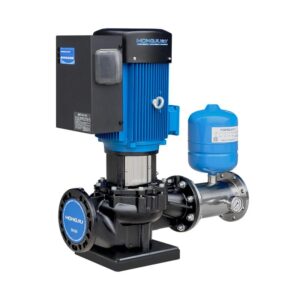
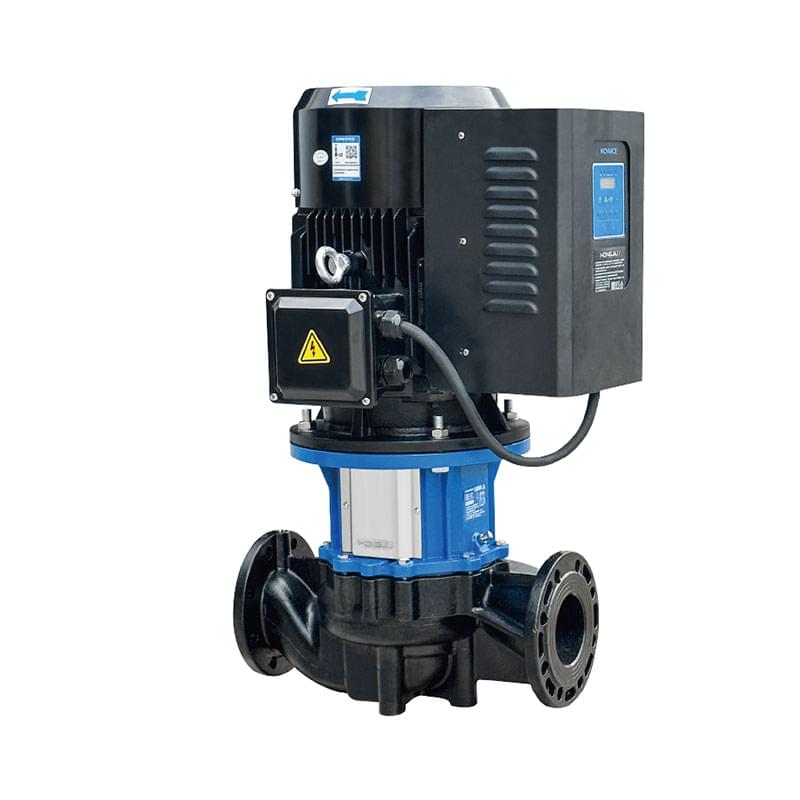
The HDGYE permanent magnet water pump from Anhui Hongjiu Water Pump Equipment Co., Ltd. changes this equation entirely. By replacing the induction rotor with rare-earth permanent magnets, it eliminates rotor current losses, achieves 95% motor efficiency, operates across an extraordinary 30 to 150 Hz frequency range, and runs 3 to 5 dB(A) quieter than equivalent induction motor pumps.
The result is not a marginal improvement. For building owners, it means 5-20% additional energy savings beyond what a conventional VFD pump already achieves — savings that compound every hour the pump runs, every day of the year, for a decade or more.
How Permanent Magnet Water Pump Technology Delivers 95% Efficiency
In a conventional induction motor, the rotor contains a cage of aluminum or copper bars. The rotating magnetic field from the stator induces current in these bars, and the resulting electromagnetic force spins the rotor. This induction process is inherently lossy: 1-3% of input energy becomes heat in the rotor bars (slip loss), additional energy is lost as rotor iron losses, and the power factor degrades significantly at partial load.
A permanent magnet synchronous motor eliminates these losses at the source. The rotor contains powerful rare-earth magnets — typically neodymium-iron-boron — that produce a fixed magnetic field without any induced current. The rotor locks into synchronism with the stator’s rotating field without slip, without rotor heating, and with a near-unity power factor of 0.95 to 0.99.
| Characteristic | IE3 Induction Motor | IE5 Permanent Magnet Motor |
|---|---|---|
| Rated Efficiency | 87 – 93% | 93 – 95% |
| Efficiency at 50% Load | 80 – 85% (significant drop) | 92 – 94% (minimal drop) |
| Rotor Copper Loss | 1 – 3% (as heat) | Zero |
| Power Factor | 0.80 – 0.88 | 0.95 – 0.99 |
| Operating Frequency Range | 20 – 60 Hz effective | 30 – 150 Hz |
| Noise vs. Equivalent Frame Size | Baseline | 3 – 5 dB(A) lower |
This efficiency advantage persists across the entire operating range. Where an induction motor’s efficiency drops sharply at partial load — the condition where VFD pumps spend most of their operating hours — the permanent magnet motor maintains near-peak efficiency from 25% to 100% load.
Technical Specifications
| Parameter | Value |
|---|---|
| Flow Rate (Q) | 5 – 1,300 m³/h |
| Head (H) | 5 – 85 m |
| Nominal Diameter (DN) | DN40 – DN300 |
| Working Pressure | 1.6 MPa (standard), 2.5 MPa (optional) |
| Medium Temperature | -25°C to +110°C |
| Motor Efficiency Class | IE5 (IEC 60034-30-2) |
| Motor Efficiency | 93 – 95% (size-dependent) |
| Frequency Range | 30 – 150 Hz |
| Power Factor | 0.95 – 0.99 |
| Control Mode | PID closed-loop constant pressure |
| VFD Integrated | Built-in, Inovance brand on 3 kW+ |
For complete performance curves, sub-type selection guidance, dimensional drawings, and detailed motor specifications, HDG Series Product Catalog →.
Three Sub-Types: Because One Pump Cannot Do Everything Optimally
The HDGYE permanent magnet water pump is available in three application-specific configurations, each with a tailored hydraulic profile, control algorithm, and factory default parameter set:
HDGYE-H: Circulation — Built for HVAC Efficiency
The -H variant is optimized for chilled water circulation, condenser water loops, and general HVAC closed-loop applications. Its hydraulic profile prioritizes smooth, stable operation at the medium-head, medium-to-high-flow duty points typical of central plant circulation.
Key design choices for the -H: The impeller trim range and volute geometry are tuned for the relatively flat system curves of closed-loop circulation. The PID default parameters favor stability over aggressive response — because a 0.1 bar pressure fluctuation in a chilled water loop is meaningless, but controller-induced hunting can waste energy and wear couplings.
Best applications: Chiller primary and secondary loops, cooling tower condenser water, data center precision cooling circulation, process cooling loops with variable heat rejection loads.
HDGYE-N: Heating Comfort — Warmth Without the Waste
The -N variant is designed for heating hot water systems where comfort, reliability, and anti-scaling performance matter more than raw hydraulic efficiency. Its profile is tuned for the higher-head, lower-flow characteristics of closed heating circuits.
Key design choices for the -N: Temperature-adaptive pressure compensation automatically adjusts the target pressure setpoint as the medium temperature changes, accounting for viscosity variation between 25°C standby water and 90°C circulating hot water. The anti-scaling control logic periodically varies pump speed within a narrow band to discourage hard-water scale deposition on impeller surfaces — a common failure mode in heating pumps operating in hard-water regions.
Best applications: Boiler circulation loops, radiator heating systems, underfloor heating circulation, district heating secondary networks, heat pump heating loops.
HDGYE-Z: Booster — Consistent Water Pressure on Every Floor
The -Z variant is engineered for open-loop water supply and pressure-boosting applications where the pump must maintain constant pressure against a highly variable and unpredictable demand profile.
Key design choices for the -Z: The hydraulic profile prioritizes high discharge pressure stability across a wide flow range. A sleep mode detects extended periods of zero demand — such as overnight in an office building — and reduces pump speed to a maintenance minimum that keeps the system pressurized while consuming negligible power. A no-flow shutdown feature fully stops the pump after a configurable timeout of zero demand, restarting automatically when a pressure drop indicates resumed usage.
Best applications: Multi-story building water supply boosting, residential community pressurization, municipal water distribution pressure maintenance, fire-fighting standby pressurization with jockey pump functionality.
The Real-World Case: A Hotel That Cut Pumping Energy by 45%
Consider a 300-room hotel in a temperate climate zone. The original chilled water circulation system used two fixed-speed inline pumps (duty/standby) with three-way control valves at each air handling unit. Design duty: 200 m³/h at 32 m head. Annual operating hours: 8,760 (continuous).
Baseline — Fixed-Speed (HDG Standard): The pump runs at full speed 24/7. Three-way valves bypass excess chilled water to maintain temperature, but the pump sees no load reduction. Motor power draw: 30 kW continuous. Annual consumption: 262,800 kWh. Annual electricity cost ($0.10/kWh): $26,280.
Upgrade 1 — Conventional VFD (HDGE): The VFD reduces average motor speed to match actual chilled water demand. Average power draw at 60% load factor: 17 kW. Annual consumption: 148,920 kWh. Annual cost: $14,892 — a savings of $11,388 per year.
Upgrade 2 — Permanent Magnet VFD (HDGYE-H): Same speed control benefit, plus the IE5 motor operates at 95% efficiency instead of 89% efficiency at the average operating point. Additional savings from reduced motor losses and higher power factor: approximately 10%. Average power draw: 15.3 kW. Annual consumption: 134,028 kWh. Annual cost: $13,403 — an additional $1,489 in savings per year compared to the conventional VFD, and $12,877 compared to the original fixed-speed pump.
Over 10 years, the HDGYE-H delivers $128,770 in cumulative energy savings compared to the fixed-speed baseline. And because the permanent magnet motor shares the same footprint as the HDG Standard and HDGE, the upgrade required no piping modifications — just a pump swap during a scheduled maintenance window.
The Ultra-Low Noise Advantage
In hotels, hospitals, residential buildings, and premium offices, pump noise is not a specification — it is a guest experience problem. An induction motor pump radiating 70 dB(A) through a mechanical room door into an adjacent guest room corridor is a complaint waiting to happen.
The HDGYE permanent magnet water pump addresses this at the source. Because there is no rotor current, there is no rotor-induced vibration. Because the motor operates in perfect synchronism with the stator field, there is no slip-frequency torque pulsation. The practical result is a noise reduction of 3 to 5 dB(A) compared to an equivalent-size IE3 induction motor — a perceptible difference that makes the HDGYE suitable for installation in noise-sensitive environments without additional acoustic enclosures.
Green Building Certification: LEED, BREEAM, and Beyond
Pumping systems account for a significant share of total building energy consumption — typically 10-15% of HVAC energy and a measurable fraction of the building’s overall Energy Use Intensity. For projects pursuing LEED (especially under the LEED v4.1 Energy and Atmosphere credit categories), BREEAM, or the China Green Building Evaluation Standard, the IE5-rated HDGYE contributes direct, verifiable points toward energy performance targets.
A permanent magnet water pump with 95% motor efficiency and a near-unity power factor reduces not only the energy metered at the pump but also the reactive power demand that influences transformer sizing and electrical infrastructure costs. In a new construction project, the lower full-load amps of the HDGYE may allow a smaller electrical feeder, a smaller circuit breaker, and proportional savings in switchgear and cabling.
Related Products
The HDGYE represents the highest-efficiency option in the HDG Series vertical inline pump family:
- Standard VFD, lower upfront cost? The HDGE VFD Pump delivers the same intelligent pressure control with an IE3 induction motor.
- Fixed-speed application where VFD payback is marginal? The HDG Standard Pump offers the same mechanical platform at the lowest purchase price.
Request a Quote with Energy Savings Projection
Tell us your duty point, operating hours, local electricity rate, and system type. Our engineering team will prepare a pump selection, complete performance curves, a 10-year lifecycle cost comparison (Standard vs. VFD vs. Permanent Magnet), and a competitive quotation — typically within 24 hours.