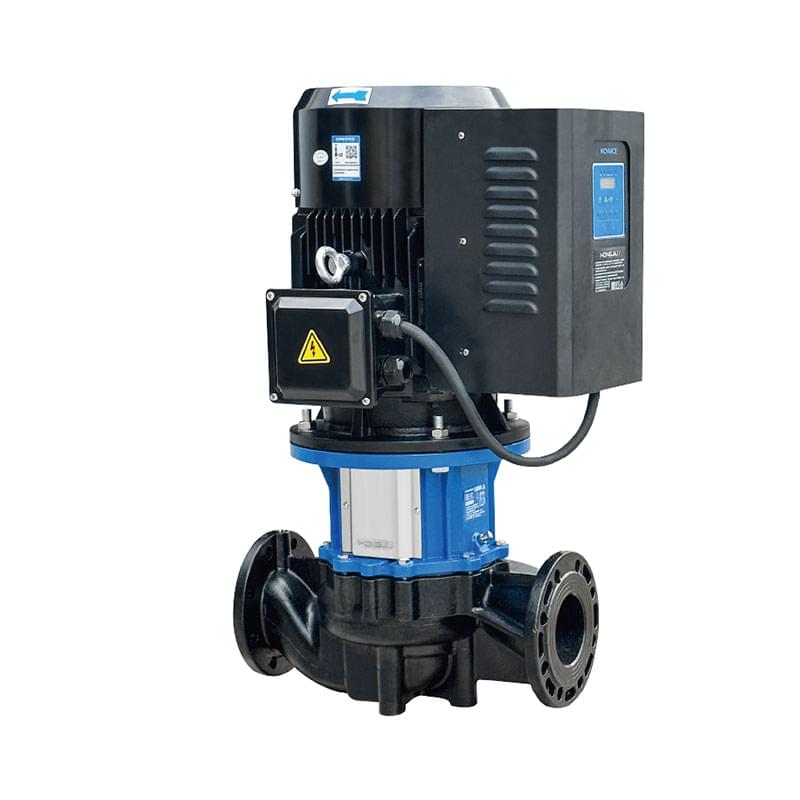








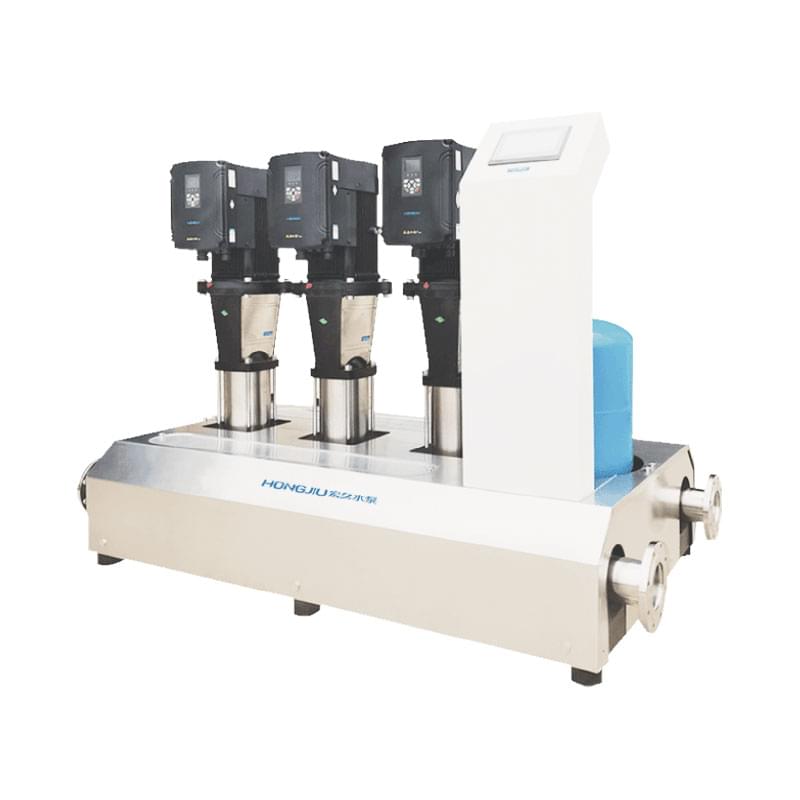

A multi pump control system coordinates two or more pumps running in parallel to maintain constant discharge pressure regardless of fluctuating water demand. Instead of operating every pump at full speed and wasting energy, Hongjiu’s single-controller architecture uses one PLC or VFD to manage the entire group — adjusting speed, adding or removing pumps, and balancing run time automatically.
How It Works
The system operates through a simple feedback loop:
- Pressure sensor installed on the discharge pipe continuously measures actual system pressure.
- PID controller compares the measured pressure against the setpoint and calculates the required pump output.
- VFD adjusts speed on the lead pump to match demand in real time.
- Automatic pump add/remove — When the lead pump reaches full speed and pressure is still falling, the controller starts the next pump on a soft starter. When demand drops, the controller removes pumps in reverse order.
The result is constant downstream pressure with minimum energy input.
Three Configuration Modes
Hongjiu offers three multi-pump control modes, each suited to different application scenarios. The table below compares them in detail.
Mode Comparison
| Feature | One-Drive-Multi-Pump (Master-Slave) | Multi-Pump Cycle Soft Start | Non-Negative Pressure Booster |
|---|---|---|---|
| Controller type | Single VFD + PLC | PLC + individual soft starters | PLC + VFD + pressure tank |
| Pump count | 2–4 pumps | 2–6 pumps | 2–4 pumps |
| Speed control | VFD on master pump only; slaves run at fixed speed | No VFD; all pumps run at fixed speed | VFD on lead pump |
| Start method | VFD soft start (master), DOL or soft start (slaves) | Sequential soft start via soft starters | VFD soft start (lead), soft start (followers) |
| Pressure regulation | PID via VFD speed adjustment | PID via pump add/remove only | PID + pressure tank buffering |
| Energy saving | 15–20% | 5–10% | 10–15% |
| Best for | Medium demand variation, cost-sensitive projects | Low variation, budget-constrained installations | Municipal/ mains-connected boosting |
| Pressure stability | Excellent | Moderate | Excellent (tank buffers peaks) |
| Complexity | Low | Low–medium | Medium |
| Typical application | Office buildings, hotels, hospitals | Small residential complexes, dormitories | Urban community supply, high-rise towers |
Mode 1: One-Drive-Multi-Pump (Master-Slave)
In the most common configuration, a single VFD drives the master pump while slave pumps are started on direct-online or soft starters. The VFD modulates the master pump speed to handle demand variations; when the master reaches full speed and pressure continues to drop, the PLC starts a slave pump at fixed speed and reduces the master’s VFD frequency to compensate.
This mode provides the best balance of energy saving, pressure stability, and equipment cost because only one VFD is required regardless of pump count.
Mode 2: Multi-Pump Cycle Soft Start
Where a VFD is not required or budget constraints apply, all pumps run at fixed speed and the PLC manages constant pressure by cycling pumps on and off via soft starters. Each pump gets equal run time through automatic rotation (cycle alternation), which extends overall equipment life.
While energy savings are lower than VFD-based modes (since all running pumps operate at full speed), the soft start eliminates inrush current spikes and reduces mechanical stress on couplings and bearings.
Mode 3: Non-Negative Pressure (Booster-on-Mains)
The non-negative pressure configuration connects the booster pump station directly to the municipal water main without a break-tank. A pressure sensor on the inlet side prevents the pumps from drawing more water than the mains can supply, ensuring that upstream users are never deprived of flow.
A small pressure tank absorbs demand spikes and reduces pump cycling frequency. The VFD on the lead pump maintains outlet pressure while respecting the inlet minimum-pressure threshold.
This mode is increasingly required by municipal water authorities in China and other jurisdictions to conserve water-supply network integrity.
System Advantages
- 5–20% energy savings compared to constant-speed multi-pump operation, depending on mode and load profile.
- Constant pressure regardless of how many taps, showers, or cooling coils are open.
- Extended equipment life through soft start/stop, which eliminates water hammer and reduces mechanical wear.
- Balanced run time with automatic pump rotation, preventing one pump from accumulating disproportionate hours.
- Reduced civil footprint — one controller cabinet replaces multiple individual starters and controls.
Applications
High-rise buildings — Multi-pump boosting is the standard solution for supplying water to floors above the municipal direct-supply zone.
Commercial complexes — Shopping malls, convention centers, and mixed-use developments with highly variable occupancy benefit from VFD-based constant-pressure control.
Industrial cooling — Process cooling loops with parallel heat exchangers use multi-pump systems to maintain flow through each exchanger as production schedules change.
Related Products
- Integrated Smart Pump Room — factory-assembled turnkey pump room with built-in multi-pump control
- Smart Water Supply System — full system overview
Frequently Asked Questions
What is PID control and why does it matter?
PID (Proportional-Integral-Derivative) is a feedback-control algorithm. In a water-supply context, it continuously calculates the difference between the target pressure (setpoint) and the actual pressure, then adjusts pump speed to close that gap. The P term responds to the current error, the I term corrects accumulated offset, and the D term dampens oscillation. The result is stable, accurate pressure without manual intervention.
How many pumps can one controller manage?
Hongjiu’s standard PLC controllers support 2 to 6 pumps per control cabinet. For larger installations (7+ pumps), multiple controllers can be networked together with a supervisory PLC. Contact the engineering team for custom configurations.
What does “non-negative pressure” mean?
Non-negative pressure means the booster system never reduces the pressure in the upstream (municipal) pipe below atmospheric. A pressure sensor on the inlet detects the mains pressure; if it drops near zero, the controller throttles or stops the booster pumps to prevent drawing a vacuum. This protects the municipal network and ensures compliance with water-utility regulations.