







When you are evaluating water pump specifications, the material conversation rarely gets the attention it deserves. Most buyers focus their analysis on flow rate, head pressure, and motor power while treating the pump body material as a minor detail. This is a costly mistake. The ductile iron vs cast iron pump body decision directly determines how much pressure your system can handle, whether the pump survives freezing temperatures, and how many years of reliable service you will get.
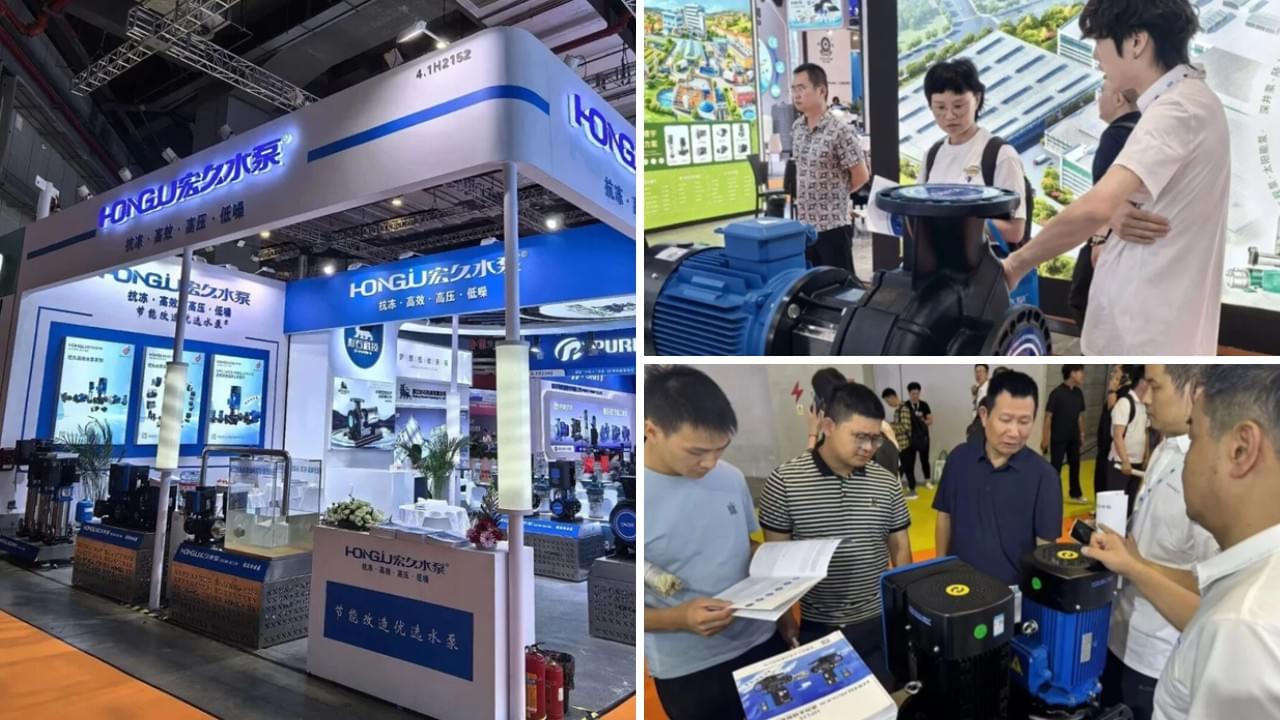
At Hongjiu Water Pump, we manufacture every HDG, HNG, and HPL series pump body from ductile iron 450-10 as our standard specification — not as a premium upgrade. This article explains exactly why that matters, with head-to-head data comparing ductile iron against the conventional gray cast iron that most competitors still use.
Understanding the Two Materials at a Foundry Level
Gray Cast Iron (HT200 / EN-GJL-250)
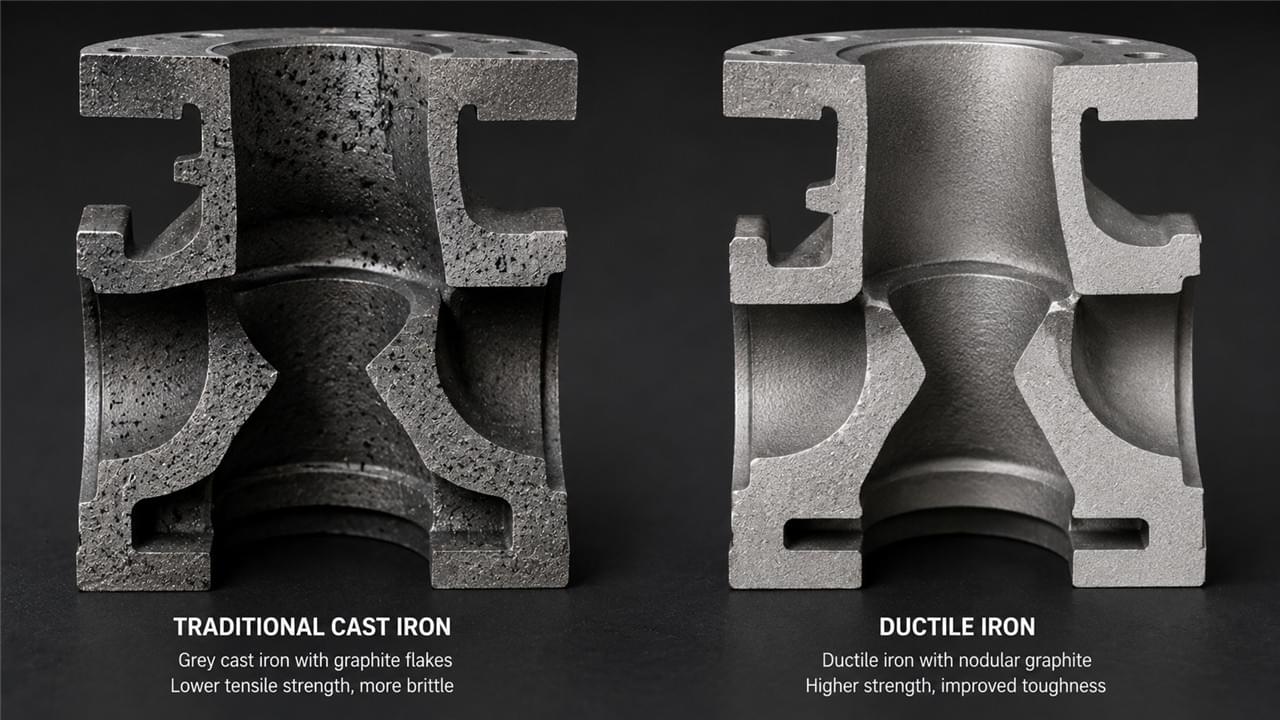
Gray cast iron has been the default pump body material for over a century. Its microstructure contains flat graphite flakes dispersed throughout an iron matrix. These flakes create natural stress concentration points that make the material inherently brittle. The HT200 designation specifies a minimum tensile strength of 200 MPa, while its international equivalent EN-GJL-250 rates at 250 MPa.
Most Chinese pump manufacturers — including major domestic brands — use gray cast iron for their standard pump bodies. It is cheaper to produce, easier to machine, and adequate for basic applications in warm climates with moderate pressure requirements.
Ductile Iron (QT450-10 / EN-GJS-450-10)
Ductile iron, also known as nodular cast iron or spheroidal graphite iron, represents a fundamentally different approach to iron casting. During the manufacturing process, a small amount of magnesium or cerium is added to the molten iron. This causes the graphite to form spherical nodules instead of flat flakes, dramatically transforming the material’s mechanical properties.
The QT450-10 designation indicates 450 MPa minimum tensile strength with 10% elongation. This material combines the castability and machinability of cast iron with mechanical properties that approach steel. According to Wikipedia’s article on ductile iron, this material was patented in 1948 and has since become essential in applications requiring high strength, ductility, and impact resistance.
Head-to-Head Material Comparison
The differences between these two materials are not marginal — they are transformative. Here is a comprehensive comparison of every property that matters for water pump construction:
| Property | Gray Cast Iron (HT200) | Ductile Iron (QT450-10) | Advantage |
|---|---|---|---|
| Tensile strength | 200 MPa | 450 MPa | 125% stronger |
| Yield strength | No defined yield point | 310 MPa | Withstands deformation without cracking |
| Elongation | Less than 1% | 10% | 10 times more flexible |
| Impact resistance | Low — cracks under shock | High — absorbs energy | Survives water hammer events |
| Fatigue strength | Approximately 100 MPa | Approximately 210 MPa | 2 times longer fatigue life |
| Pressure rating | Standard 1.6 MPa | Standard 1.6 MPa, optional 2.5 MPa | 56% higher maximum pressure |
| Anti-freeze capability | Not rated | Static freeze resistance to -15°C | No burst risk in cold climates |
| Temperature range | -20°C to +140°C | -25°C to +120°C | Better low-temperature performance |
| Corrosion resistance | Moderate | Better uniform structure | Extended service life |
Difference 1: Tensile Strength — 450 MPa vs 200 MPa
Tensile strength measures the maximum stress a material can withstand while being stretched or pulled before breaking. At 450 MPa, ductile iron is more than twice as strong as gray cast iron at 200 MPa. This directly translates to greater resistance to internal pressure, external forces, and mechanical stress during installation and operation.
In practical terms, a ductile iron pump body can handle pressure surges and mechanical impacts that would crack a gray cast iron body. For high-rise buildings, district heating networks, and industrial applications where pressures regularly approach or exceed equipment ratings, this strength margin provides critical safety assurance.
Difference 2: Anti-Freeze Protection — -15°C Static Resistance
This single difference can save thousands of dollars in replacement costs. In cold climates across Northern China, Canada, Northern Europe, and Russia, water left inside a pump during winter can freeze and expand by approximately 9% in volume. Gray cast iron, with less than 1% elongation, cannot accommodate this expansion and typically cracks catastrophically.
Ductile iron’s 10% elongation allows the material to flex and absorb the expansion pressure from freezing water. Hongjiu’s ductile iron 450-10 pump bodies carry a rated static anti-freeze specification of -15°C. This means water frozen inside the pump during a winter shutdown will not crack the body — a critical safety feature for any installation in a cold climate.
Seasonal buildings such as ski resorts, holiday homes, and vacation facilities face particular risk. These properties often shut down their water systems during off-season months, leaving pumps vulnerable to freeze damage. A single freeze event can destroy an entire pump unit, requiring full replacement including labor and system downtime.
Difference 3: Pressure Rating — 2.5 MPa vs 1.6 MPa
Hongjiu offers ductile iron pump bodies rated for 2.5 MPa as an option — a 56% increase over the standard 1.6 MPa rating of gray cast iron bodies. This higher pressure capability matters enormously in several real-world scenarios.
Consider a 20-story building where static water pressure alone reaches approximately 2.0 MPa based on the formula of 200 meters of elevation multiplied by 0.01 MPa per meter. When you add pump discharge pressure and dynamic pressure surges from valve operations, total system pressure can exceed 2.5 MPa. A gray cast iron pump body rated for 1.6 MPa has absolutely no safety margin in this situation.
District heating systems routinely operate at pressures between 1.0 and 2.5 MPa, with temperature fluctuations causing additional thermal stress. Mining dewatering applications may experience sudden pressure spikes from rock falls blocking discharge lines. In every high-pressure scenario, ductile iron’s higher rating provides the margin of safety that engineers and building owners require.
Difference 4: Impact and Water Hammer Resistance
Water hammer occurs when a pump stops suddenly or a valve closes rapidly, sending a pressure shock wave through the piping system. These shock waves can generate pressures two to five times higher than normal operating pressure. The damage is often instantaneous and catastrophic.
Gray cast iron’s brittleness — with less than 1% elongation — means it cannot absorb these shock waves. A severe water hammer event can cause sudden, complete cracking of the pump body, leading to immediate flooding and system failure. Ductile iron’s 10% elongation and high impact resistance allow it to absorb and distribute shock energy without fracturing.
This property is especially important in tall buildings with long vertical pipe runs where water hammer forces are amplified by the water column weight. Systems with fast-closing automatic valves, fire protection installations, and mining applications all benefit significantly from ductile iron’s superior shock absorption.
Difference 5: Fatigue Life Under Cyclic Pressure Loading
HVAC systems cycle between heating and cooling modes throughout the day. Building water supply systems experience daily demand patterns with morning peaks, midday plateaus, and nighttime troughs. Each cycle creates pressure fluctuations that gradually fatigue the pump body material over time.
Gray cast iron pumps may develop micro-cracks after 50,000 to 100,000 pressure cycles. These micro-cracks can propagate into leaks or catastrophic failures. Ductile iron’s fatigue strength of approximately 210 MPa — double that of gray cast iron — enables it to withstand millions of pressure cycles without material degradation.
For a pump operating in a typical commercial building with 365 heating-cooling cycles per year, this means ductile iron can provide reliable service for decades beyond what gray cast iron would tolerate. The longer fatigue life directly translates to lower lifecycle costs and fewer unexpected replacements.
Difference 6: Weight Considerations
Ductile iron is approximately 10% heavier than gray cast iron for identical dimensions. For a DN100 pump body, this means roughly 38 kg compared to 35 kg in gray iron. The difference is negligible for individual pump installations and easily accommodated by standard foundations.
For large installations with dozens of pump units, the cumulative weight difference may reach several hundred kilograms. However, this additional weight is distributed across the pump pad or foundation, which is typically designed with substantial structural capacity. The 10% weight increase is a minimal trade-off for 125% more strength, anti-freeze protection, and dramatically longer service life.
Difference 7: Cost and Total Cost of Ownership
Ductile iron raw material costs approximately 15-25% more than gray cast iron. This is the primary reason most competitor brands continue using gray cast iron — it reduces their manufacturing cost. However, the purchase price comparison tells only part of the story.
Hongjiu achieves factory-direct pricing that is already 20-30% lower than branded alternatives from international manufacturers. This means our ductile iron pumps may cost the same or less than competitors’ gray iron pumps. When you factor in the longer service life, reduced failure risk, and anti-freeze protection, the total cost of ownership of a ductile iron pump is substantially lower than a gray cast iron alternative.
In cold climate applications, the anti-freeze feature alone can save thousands of dollars from preventing a single freeze-related failure. One replacement pump — including labor, system downtime, and water damage — typically costs far more than the material upgrade.
Hongjiu Ductile Iron Quality Assurance Process
Every ductile iron pump body we produce undergoes a rigorous five-step quality verification process. Spectrometric analysis tests every batch of raw iron for precise chemical composition. Tensile testing pulls sample castings to verify the 450 MPa minimum tensile strength specification.
Metallographic microstructure examination confirms the spherical nodular graphite structure that gives ductile iron its unique properties. Hydrostatic pressure testing subjects every pump body to 1.5 times its rated pressure to verify structural integrity. Finally, CNC precision dimensional inspection ensures perfect alignment with motors and piping connections.
This quality process is not optional — it is applied to 100% of production. Every pump ships with a complete test report documenting actual performance data.
Material Selection Guide by Application
| Application | Recommended Material | Key Reason |
|---|---|---|
| HVAC circulation systems | Ductile iron | Cyclic pressure loading, long service life requirements |
| High-rise building water supply | Ductile iron | High static pressure, water hammer risk |
| Cold climate installations | Ductile iron | Anti-freeze protection essential |
| District heating networks | Ductile iron | High temperature, high pressure, constant cycling |
| Mining and industrial | Ductile iron | Impact resistance, abrasive environments |
| Light-duty residential warm climate | Cast iron acceptable | Lower pressure, no freeze risk, cost sensitive |
Ductile Iron vs Cast Iron Pump: The Verdict
The comparison is not close. Ductile iron is objectively superior to gray cast iron in every mechanical property that determines pump durability: tensile strength, impact resistance, fatigue life, pressure capability, and freeze survival. The higher material cost is small compared to the extended service life and eliminated failure risk.
At Hongjiu, we decided years ago that ductile iron 450-10 would be our standard pump body material across all product lines. We believe every customer — whether in a warm tropical climate or a freezing northern region — deserves the most durable, reliable pump body available. It is not an upsell. It is our baseline.
Compare pump specifications and explore our HDG vertical inline pump, HNG horizontal end suction pump, and HPL compact inline pump series with complete technical data sheets. Every model features ductile iron 450-10 construction as standard. Contact our sales engineers for pricing on ductile iron pump solutions tailored to your project requirements and operating conditions.